Here’s the second of our series of blogposts by Mary Morrison in which she reflects on the Aire Air Sunnd project led by Comann Eachdraidh Uibhist a Tuath. As with her previous post comments are welcome!
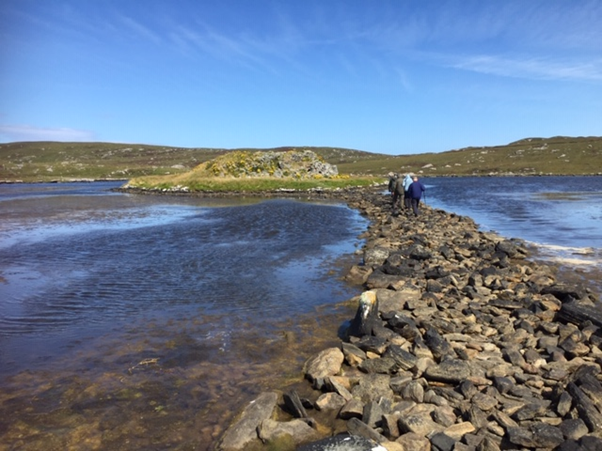
Picture – Vanessa Langley: Gaelic heritage walk to Dùn an Sticir
Mary writes:
Pool of scattered thoughts – The Feedback Imperative.
The organiser’s bane, the participants’ nightmare and the funders’ staple diet.
When, however, that feedback comes in the form of a poem, reflecting on CEUT’s Gaelic heritage walks and summer festival, such creative ‘evaluation’ from a participant can be astonishing, rewarding and moving.
A BLESSING
A blessing to walk this green land
with its flowers,
yellow and purple.
To learn is history
ancient and old.
A blessing to hear tales from people
whose ancestors roamed here,
Interesting stories from a land
surrounded by white sands
and the wild waves of its light blue sea.
A blessing to learn the language
amid strawberries and cherries
biscuits and tea.
A language familiar
but also unfamiliar.
Meleri, thank you for your inspirational writing.
(By the way, the strawberries and cherries were not growing on the machair, but shop bought, to put on the tables at Sgoil Chàirinis during our wellbeing afternoons!)
We are always glad for Comann Eachdraidh Uibhist a Tuath to get any feedback about our funded activities, but a gift, such as this poem, is a lasting treasure for those darker moments in voluntary organisations. Any volunteer feels some guilt and embarrassment when imposing the feedback chore on participants in their activities; it’s as if you are coercing guests at a meal to try out one more helping, one cake too many? And it’s always hard to know the best way to do this. Recently, because it was mostly too windy to hand out the prepared slips of paper, or to expect responses on the spot, we sent a ‘no pressure’ email after each of CEUT’s four Gaelic heritage walks, leaving it open for people to reply – a method that evoked only a few written responses. However those who did reply astonished us with their creative, thorough and honest reflections.
We sent out fifty emails to those who had joined one or more of our walks, as follows: If you have time, you might like to reflect on how you felt about the walk. Here are some prompts you can use:
- What part or aspect of the walk did you enjoy most – and why?
- Did you learn anything new on the walk?
- How important is it to use the Gaelic place names and related stories ?
- Should CEUT provide more of these walks?
- Do any special feelings on or after the walk come to mind?
If you have any photos, writing, or art work inspired by the walk please feel free to share these.
Many of you sent in your telling and expert photographs; we have archived these as your active testimonies to the walks. Taing mhòr.
One of the written reflections came from an enterprising cyclist, Janey, who had come to the island from New Zealand on an international cyclists exchange scheme. (A scheme where you stay free with a host for six weeks, provided you work in the house or garden for four hours a day, and try not to use any public transport other than ferries or trains for longer journeys.)
We have learnt a lot from her detailed and constructive email – thank you Janey! Thanks too for your shock on another occasion. You pointed out that in New Zealand everyone brings her/his own cup to gatherings to conserve energy, time and the planet. Right now, at Sgoil Chàirinis, CEUT doesn’t make people bring their own cup with them, but your observation is timely – we do need to think about reducing waste and energy wherever possible!
You then alerted us to the ‘www.ebi’ method of getting feedback, ‘what worked well, even better if’ and pointed out that this wasn’t part of what we had asked for. It should have been; thank you – we will make sure we use this, and will be reminded of you, in future.
Under that heading you gave us some excellent pointers for the future:
- a very brief round of everyone at the beginning before setting off – who/ from where/ historical connections to this area/ what, if anything, is your particular interest in the history of this area? This would have helped me connect more easily with others during the walk.
- I’d have enjoyed a very brief teaching of one (Gaelic) phrase, each time and be encouraged to practice this with others as we walk. This would bring the language alive for me and add an element of fun and connection with others.
- I’m curious if the locals’ stories that people share of their history get recorded anywhere. (Perhaps a ‘scribe’ could be appointed at each walk so that this information becomes part of the next newsletter?) The sharing and gathering of these local stories seems an important element in building this group.
- I would enjoy being offered the chance to bring a thermos and biscuits and take a 10 minute break half way through the walk shared with others – to me sharing food together builds community
Well, I immediately realised that one of the new features we had tried to build into the walks, (a QR code to scan, to provide an information sheet and a contact email for further details), didn’t seem to have worked very effectively. Was it the unfamiliarity of such technical methods, the poor connectivity on the islands, or had we not provided enough information on the posters? How can we do this better next time?
Weather permitting, the idea of ‘sharing’ a snack seems a great idea! We encourage everyone on the handouts, (that didn’t connect this time), to bring these, but marking out a ‘Janey’ spot will become a feature of these walks in future.
We must also try to be more aware of the ways in which we can build in further inclusiveness; firming up the pre-walk contacting, information and introductions will be essential next time.
Other responses to our questions may have suggested that we only wanted to hear about what worked well? Finding better ways of teasing out what we can do better, so as to guard against being too celebratory, inviting non-critical evaluation will shape our next steps. An area to explore further with our research partners.
We will, however look at some of the celebratory vignettes, drawn from five emails, under the questions we posed for the meaning they convey:
- What part or aspect of the walk did you enjoy most- and why?
– the part I enjoyed most about the walk was hearing different people’s stories adding and enhancing the basic history of each site – my sense this group could be reframed as a ‘History Club’ – that was how it came across to me – the informality, friendliness and shared contribution was welcome; I was expecting the stuffiness and hierarchical nature of a ‘society’! – North Uist itself is so full of the ruins of human habitation, you are literally tripping over them, and I started to see every mound and rock as something possibly archaeological!
- Did you learn anything new on the walk?
I valued the chance to hear about local history from those with ‘lived experience’
I learnt so much more about the Teampull, its history over such a long period of time, the people that have stood on the same piece of earth I was standing on!
From Neolithic to the more modern (Vallay House), we can see that humans are transitory in the landscape but leave their mark, we are tiny and nature is so much bigger than us. Emphasises we are as humans the same, despite what age we live in.
- How important is it to use the Gaelic place names and related stories?
I cannot stress enough the importance of using Gaelic names and related stories, after all that is what they are. I may not understand the language, but it means so much to me to get a full and complete picture to immerse myself in. It feels rounded and whole by being true to the Gaelic language.
I valued the Scots Gaelic being spoken and the way you introduced it as important for community.
Wonderful to learn and hear Gaelic spoken.
- Should CEUT provide more of these walks?
What you are doing is so good, please keep on with walks/feedback as I think they are invaluable.
Thank you for organising these wonderful and interesting walks. So very glad I came across them.
- Do any special feelings on or after the walk come to mind?
I felt joy in having knowledge of the (Priest’s) Stone to feedback to my host in Middlequarter as well as to other locals. None of them previously knew of the stone and its significance.
Afterwards I have been left thinking how everyday life would have been for those living within the place over all the centuries. How somewhere so quiet and beautiful was the setting of such a gruesome battle (Ditch of Blood) and the dichotomy of that. The graves, the oldest I found being hand carved and beautiful (so much effort and care), the most recent the war grave of 17 year old A Macauley (what a serene place for him to rest, so young, so sad).
p.s. I will follow on with more photos, can only do a few at a time!
The detail here is imaginative and expressive. These visitors captured eloquently, as the poem did, how allowing the Gaelic storytelling breaks, whilst exploring the sites we visited, gave walkers time to enter and reimagine our Gaelic past.
So we need from our researchers how best to turn these reflections into evidence for our funders? In what ways can we articulate how our Gaelic walks to heritage sites help community wellbeing? Do we really need to quantify experiences that seem to be unique to each walker for any evaluation to count as valid?
This blogging cailleach, in inviting these responses, was reminded to look up a quotation from her PGCE days, which had served her well, both to inspire writing in the classroom and, at times, to resolve conflicts within and without it:
Everyone sees a different moving picture of an event in which all are involved.
There are differences in interpretation and disagreement about what actually happened, but these are not necessarily right or wrong. The accounts differ because we all played a different part in the same ball game. Shipman, 1974.