Probably most people in North Uist recognise the importance of the Gaelic language to the local culture, even if not all speak it themselves. But in the interests of “inclusion” there is an often-felt pressure on Gaelic-speakers to use English more and more, and Gaelic less and less. This can be true, perhaps even particularly so, in community groups with a mission to bring people together around a common interest – such as local history, for example.
This is one of the issues that Comann Eachdraidh Uibhist a Tuath are attempting to address in new ways through the Ideas Fund “Aire air Sunnd” project, in which the Universities of Aberdeen, St Andrews, and the Highlands and Islands team up to provide research support for well-being initiatives on the island.
Part of the Island Voices contribution is to enable the viewing of selected extracts from the Guthan nan Eilean collection in order to stimulate Gaelic discussion, reminiscence, and ideas, and perhaps the airing of questions and concerns, so creating a contemporary and accessible record of speakers’ thoughts, memories, and opinions. Recordings of these discussions can then be transcribed for wider dissemination to enable any and all interested community members to gain increased knowledge and understanding of local stories, customs, practices, and issues, without first requiring them to be voiced in English.
That’s the theory, at least. Now for the practice! Here’s a first attempt. What do you think? (You can turn subtitles on and off on YouTube, and select a wide range of languages – including English – into which to translate the original Gaelic.)
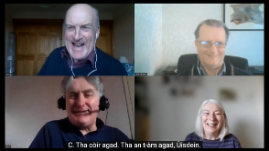
Members and supporters of Comann Eachdraidh Uibhist a Tuath, the North Uist Historical Society, view and discuss Norman Maclean’s telling of the Battle of Carinish.
“Norman luk api pan fiim tuu piej. Di nyuuz bou di wok dem ina Lochboisdale riili gud, an elp buus op kanfidens ina wan komyuuniti we a chrai aksep se nyuu teknaliji a kom bout. Di regila advataisment dem an komyuuniti fiicha mek evribadi memba di sorvis dem we de bout an mek dem tankful se dem liv de.” (Jamiekan)
“Gu dearbh, tha coltas toilichte air Tormod air an dà dhuilleag aige. ’S e naidheachd air leth a th’ ann cuideachd mu na h-obraichean ann an Loch Baghasdail, agus cuiridh sin ri misneachd ann an coimhearsnachd a tha airson buannachd fhaighinn a-mach às an teicneòlas ùr. Bidh sanasan agus sgeulachdan bhon choimhearsnachd a’ toirt gu aire a h-uile duine na seirbheisean a tha ri fhaighinn, agus na h-adhbharan eile a th’ aca airson fuireach an seo.” (Gàidhlig)
“Norman is indeed looking happy in his two-page spread. The news about the jobs in Lochboisdale is excellent, and helps to boost confidence in a community wishing to embrace the potential of new technology. Regular advertisements and community features remind everyone of the services that are available and why they appreciate living here.” (English)
Kadeyne Marshall’s narration last year of Di Nyuuzpiepa was the third Jamaican version of an Island Voices film, and complements Hugh Campbell’s Gaelic Jorni and Dijitaizieshan Senta, all provided through the Jamaican Language Unit of the University of the West Indies, thanks to Audrey West‘s inspired introduction. Following the 2022 signing of a Memorandum of Understanding with the University of the Highlands and Islands, we hope to see further collaborative work developing out of these small but concrete initial steps with the Jamaican Language Unit and their media channel Braadkyaas Jamiekan.
Followers of Island Voices who have sampled our Talking Points page will also be familiar with the voice of Dr Joseph Farquharson, the Jamaican Language Unit co-ordinator, discussing – in English – various sociolinguistic points arising from the Normal Maclean Saoghal Thormoid recordings with academic and community partners. As part of the JLU 20th anniversary celebrations, you can hear him here – in Jamaican – explain more about the work of the unit. It’s a fascinating story of language study and linguistically-informed language activism from another island context.
Island Voices co-ordinator Gordon Wells was particularly interested to hear the name of Robert Le Page mentioned – a relatively unsung but key sociolinguistic pioneer who headed the department at York University where Gordon’s own linguistic career began. Saoghal beag…
 Probably most people in North Uist recognise the importance of the Gaelic language to the local culture, even if not all speak it themselves. But in the interests of “inclusion” there is an often-felt pressure on Gaelic-speakers to use English more and more, and Gaelic less and less. This can be true, perhaps even particularly so, in community groups with a mission to bring people together around a common interest – such as local history, for example.
 “Norman luk api pan fiim tuu piej. Di nyuuz bou di wok dem ina Lochboisdale riili gud, an elp buus op kanfidens ina wan komyuuniti we a chrai aksep se nyuu teknaliji a kom bout. Di regila advataisment dem an komyuuniti fiicha mek evribadi memba di sorvis dem we de bout an mek dem tankful se dem liv de.” (