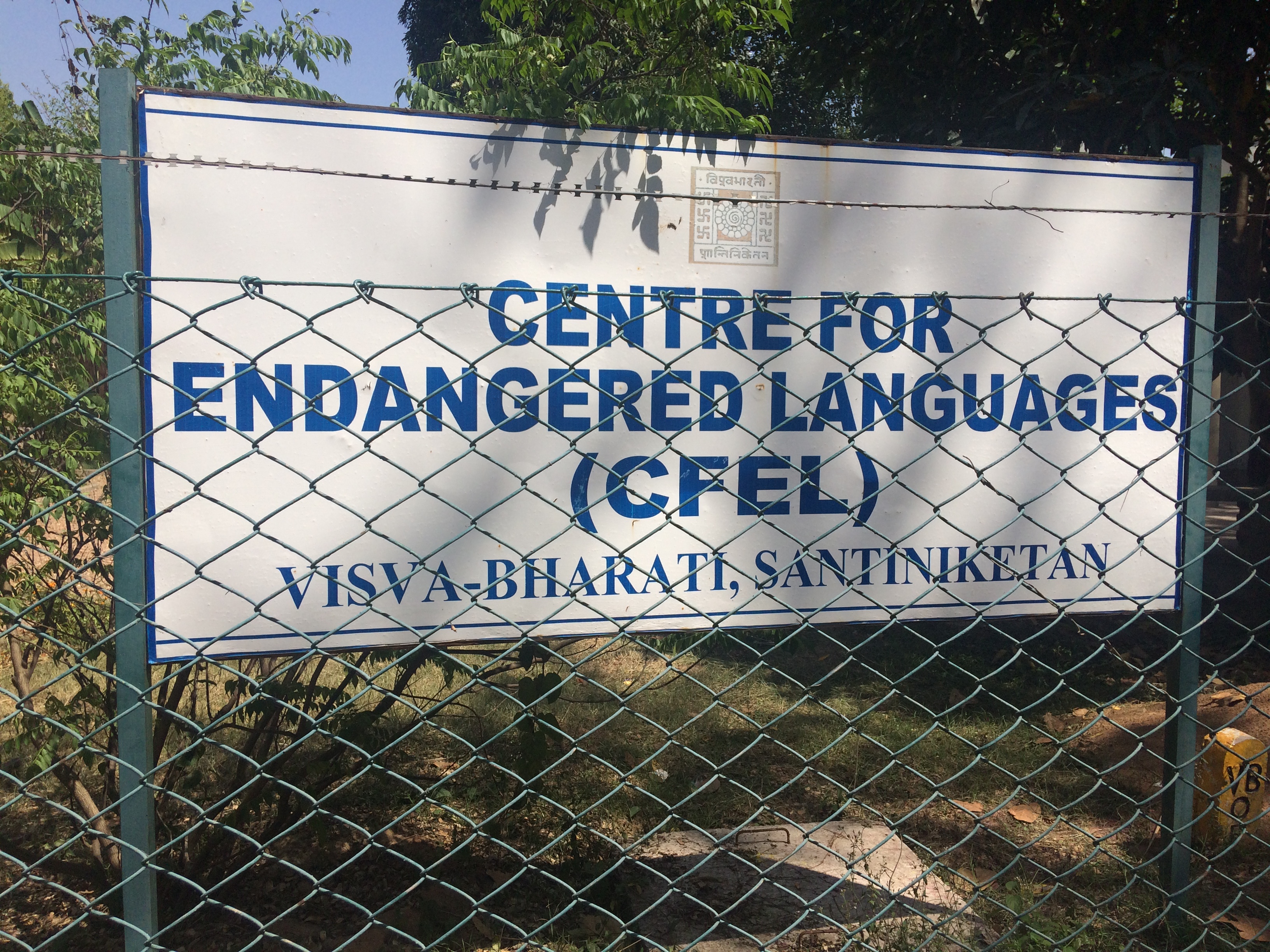
Island Voices co-ordinator Gordon Wells’s “lightning tour” of India concluded with a session in the Bhasha Bhavana (Languages Building) of the world-famous Visva Bharati University at Shantiniketan. Wearing hats from both Guthan nan Eilean and Soillse (for which he is the project manager), Gordon Wells delivered a summary of the overall Island Voices project while highlighting the partnership with Soillse, particularly in relation to Saoghal Thormoid.
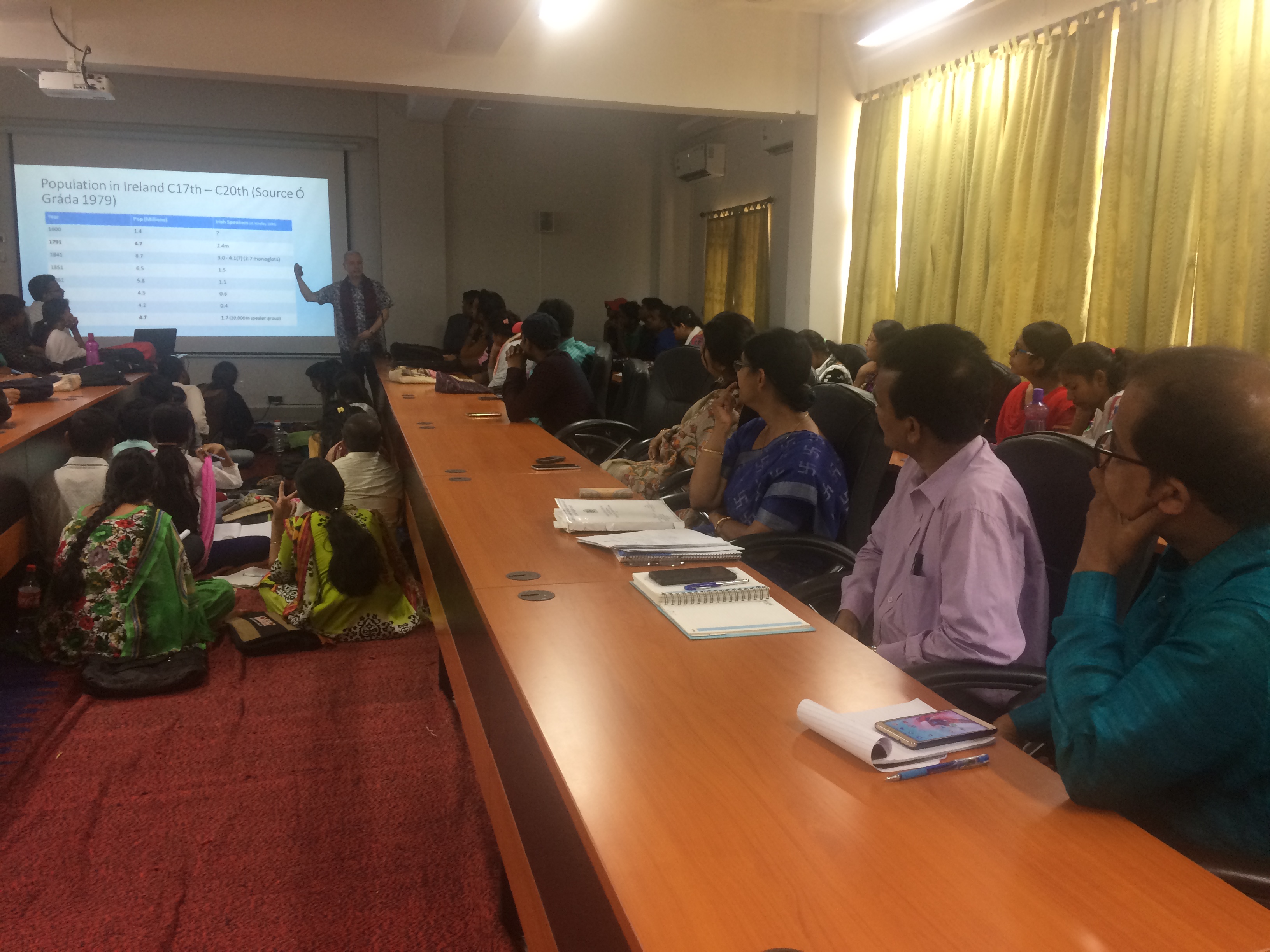
Conchúr Ó Giollagáin’s talk. (Click to enlarge.)
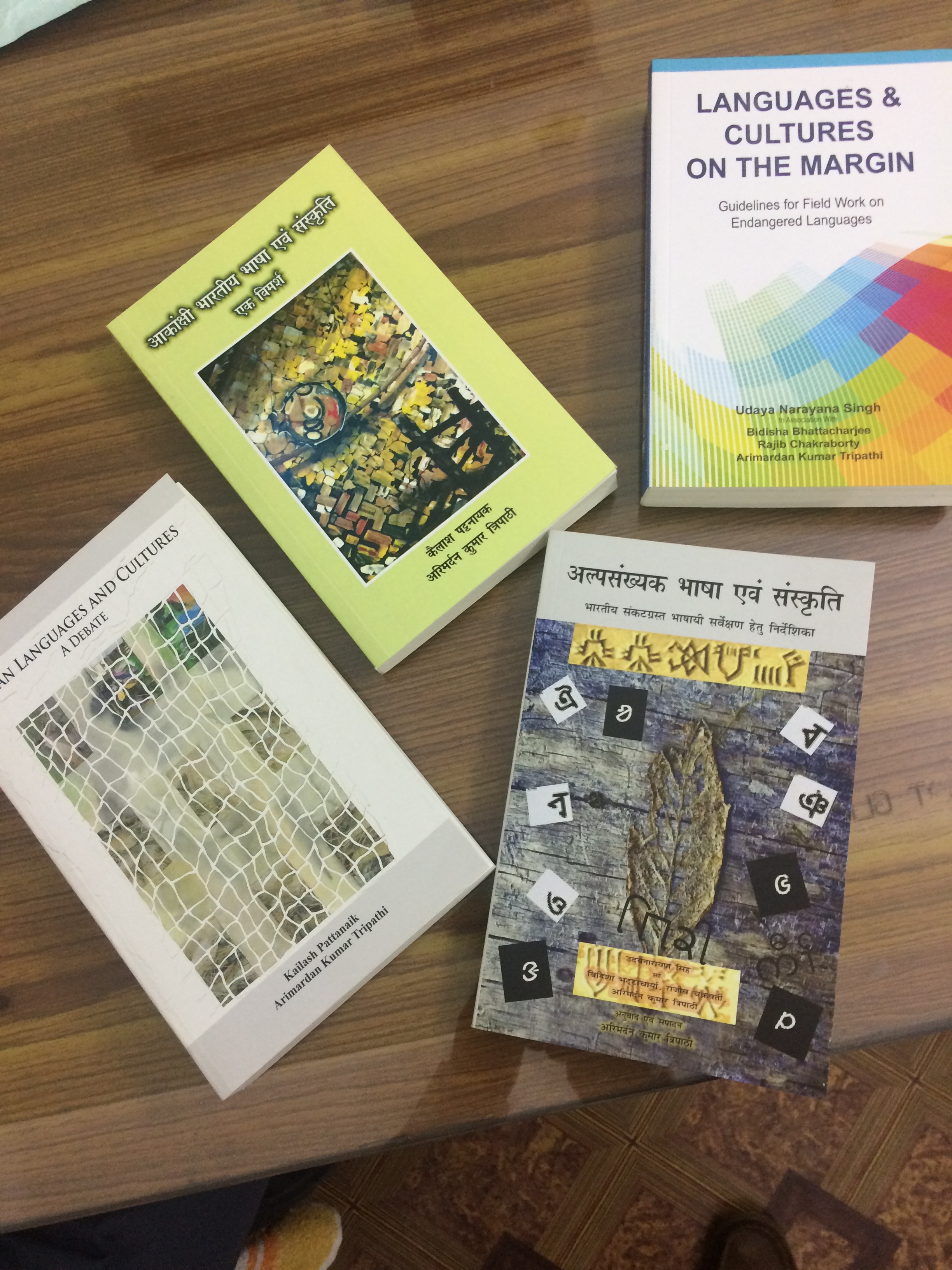
CFEL publications. (Click to enlarge.)
Like the previously visited Jadavpur University in Kolkata, Shantiniketan also hosts a Centre for Endangered Languages, another link in a chain that connects many different parts of India. Soillse Director, Conchúr Ó Giollagáin, who also spoke in all three venues on the tour, is keen to develop dialogue and links between Irish and Scottish Gaelic interests and Indian efforts and initiatives to protect and promote linguistic diversity. In his talks on Irish and Scottish Gaelic culture and demography he noted in particular the striking disparity in international academic attention and resources devoted to India, with its rich mix of languages and cultures, in comparison with, for example, Western Europe which has far less linguistic variety.
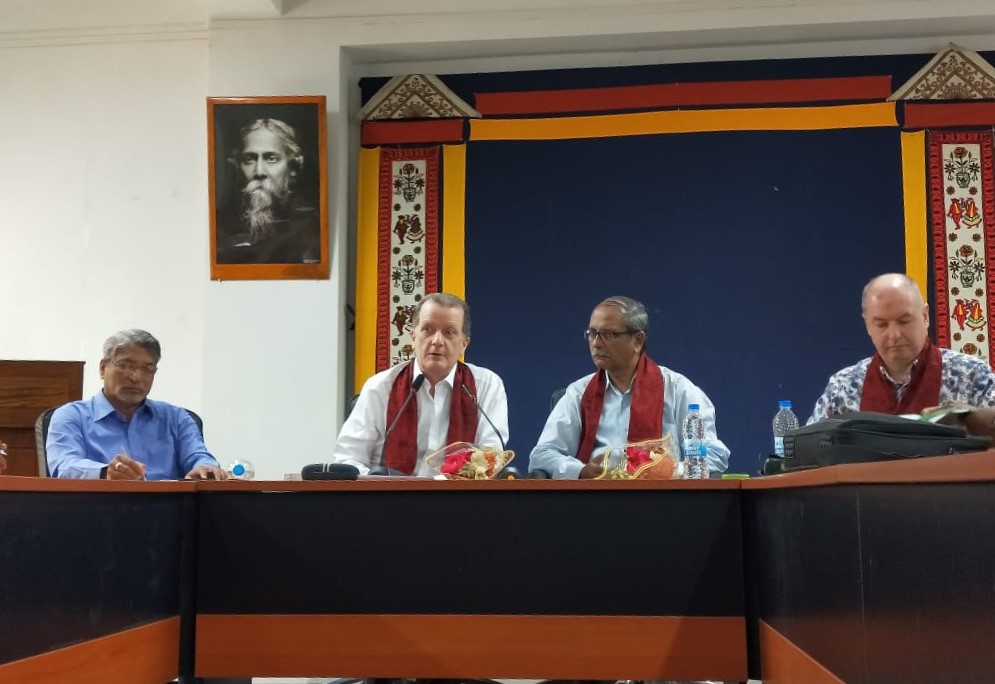
The speakers, hosted by Profs Kailash Pattanaik and Abhijit Sen. (Click to enlarge.)
Both visitors certainly found Shantiniketan an inspiring venue to complete their tour, where they were warmly received by faculty members, research scholars, and students, and treated to a fascinating tour of the campus, as well as Rabindra Bhavan, which houses the Rabindranath Tagore museum.
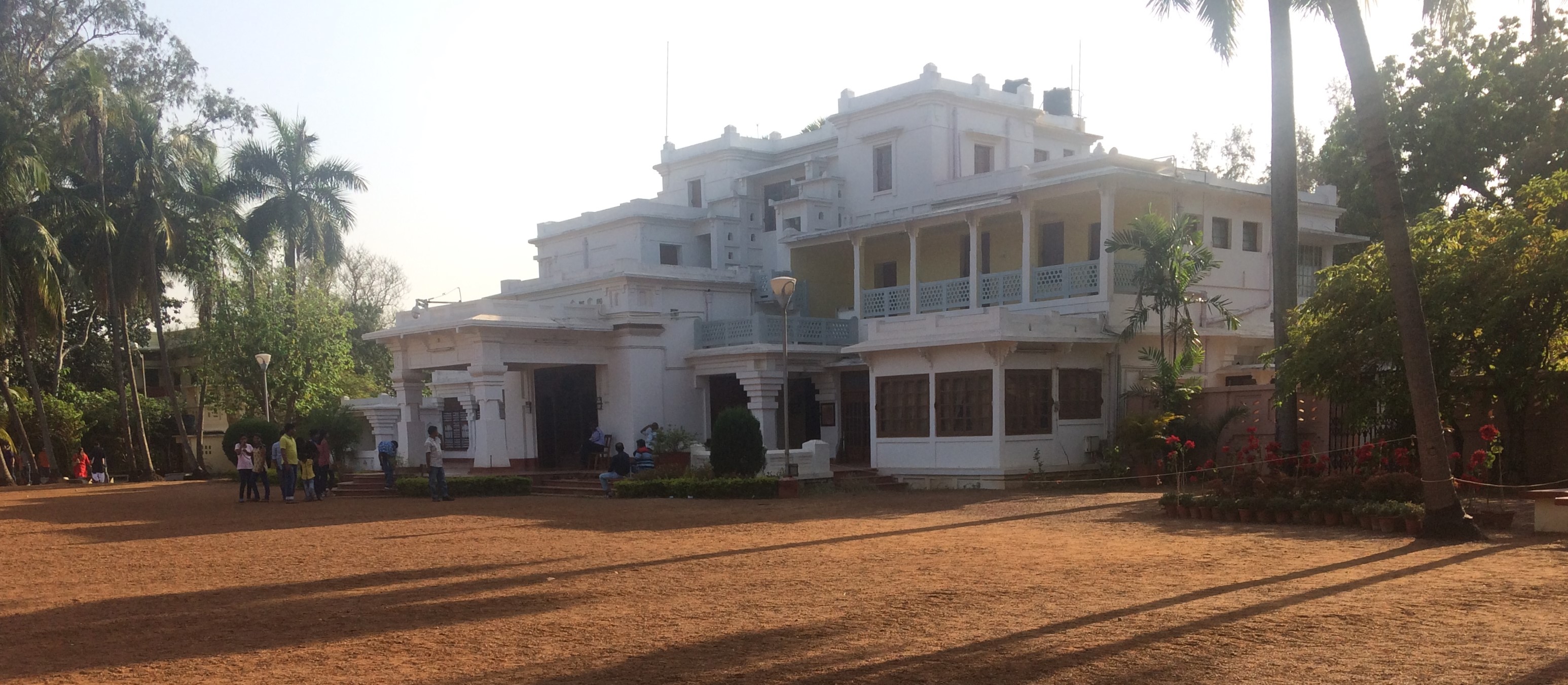
Rabindranath Tagore’s house. (Click to enlarge.)
A PDF of Gordon’s presentation with live links can be viewed here.
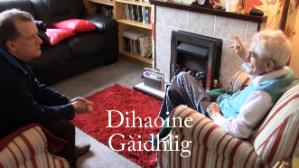
“So, tha cunnart ann a bhith a’ dèiligeadh le aon chànan a-mhàin… Ma tha cànain eile agad tha an saoghal a’ sìor leudachadh a-muigh, agus faodaidh tu roghainn a dhèanamh, faodaidh tu deagh thaghadh a dhèanamh.”
(“So there’s a danger in dealing with only one language… If you have other languages the world keeps widening out, and you can make choices, you can make good choices.”)
This extract from Saoghal Thormoid, particularly in keeping with the theme of the Indo-Scottish colloquium at Amity University Haryana, was used as the final example in Gordon Wells’s second presentation, in which he was invited to speak on aspects of Video Documentation in an ethnographic context.
The PDF of the presentation, with live links to further exemplifying material is available here.
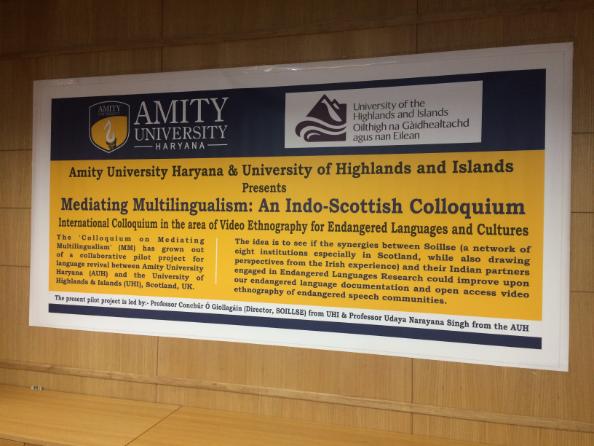
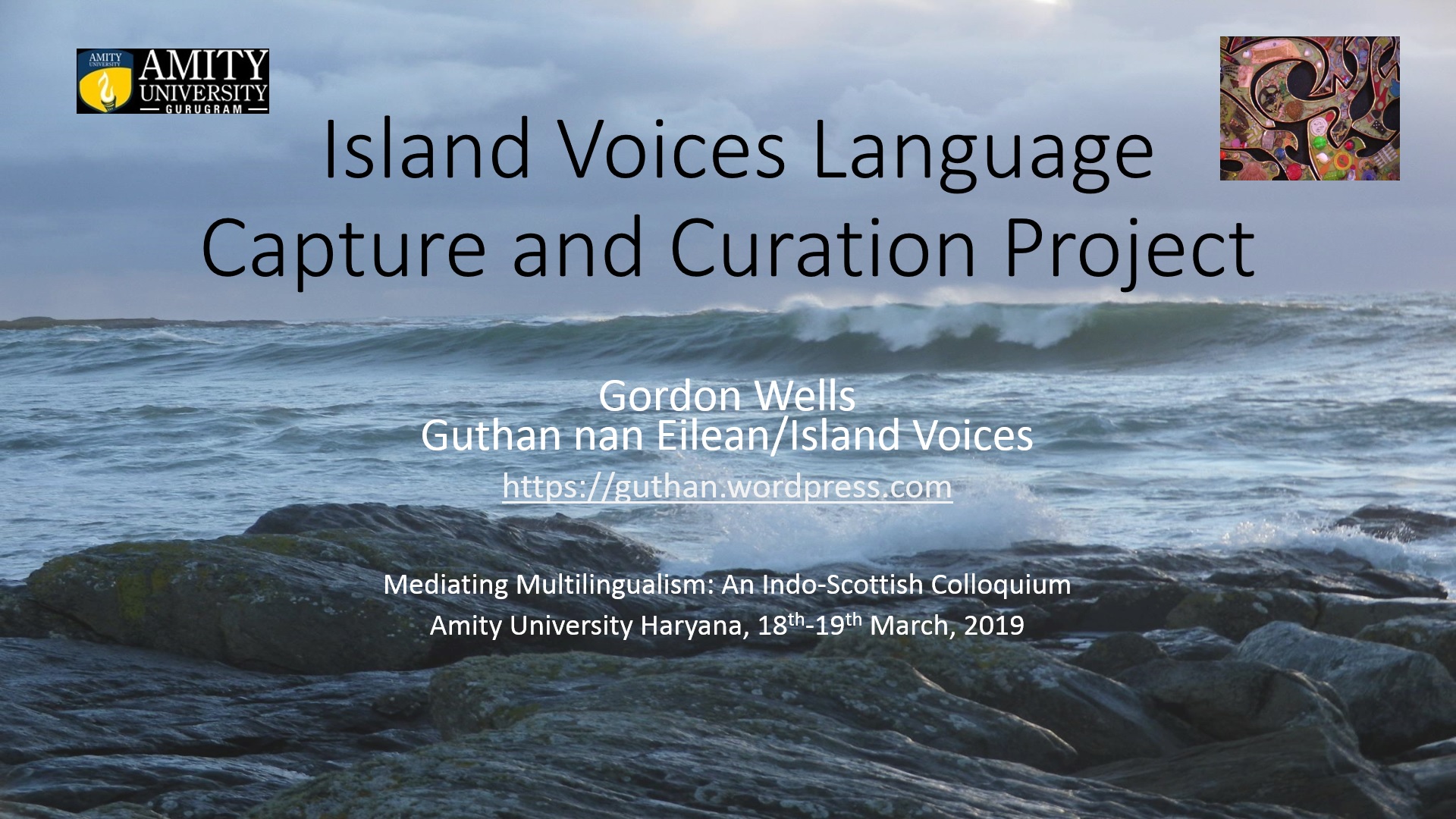
As part of the “Mediating Multilingualism” colloquium held at Amity University Haryana, Gordon Wells was invited to speak about Island Voices. Here are his introductory remarks:
“Latha math, a chàirdean. Tha e na urram dhomh a bhith a’ bruidhinn ribh aig a’ choinneamh an seo, agus tha mi airson taing mhòr a thoirt dhan fheadhainn a rinn obair mhòr airson a cur air dòigh. Agus tha mi gu math dòchasach gum bi deagh chòmhradh againn thairis air an dà latha a tha romhainn.
Much as I would love to continue speaking in my mother’s Mother Tongue for the next half hour, I suppose I should switch to our shared Other Tongue for the purposes of EFFECTIVE communication across languages, with some regret if the communication loses some of its AFFECTIVE power through not being delivered in what my mother claimed to be the “Language of Eden”! (I was just saying it’s an honour to be here, and we’re very grateful to our Amity colleagues for all the preparatory work to set this colloquium up.)
I plan to outline the development of the project over the last 10 to 12 year period, give an overview of its component parts, and generally talk about how it works. It’s a project that was designed and developed to meet a particular geographical and linguistic need. Whether any of its elements may be open to transfer or adaptation to other contexts is an open question, which I would hope we may be able to discuss in due course.
इसके ऊपर मैं यह भी कहना चाहता हूं कि, हमारी तरफ़ से, हम जानते हैं कि भारत एक बहु-भाषीय देश है जहां बहुत बहुत अलग अलग भाषाएं साथ-साथ चलती रहती हैं, और हमें उमीद है कि दोनों भी तरफ़ से हम एक दूसरे से कुछ न कुछ नयी जानकारी सीख सकें जिस का इस्तेमाल हम, आगे बढ़के, अपनी ही स्थितियों में, कर सकें.
In the UK, and perhaps also Ireland, recognition and acceptance of multilingualism in culture and society is an ongoing challenge. How India handles these issues on a much wider scale is of keen interest to us.”
 Island Voices co-ordinator Gordon Wells’s “lightning tour” of India concluded with a session in the Bhasha Bhavana (Languages Building) of the world-famous Visva Bharati University at Shantiniketan. Wearing hats from both Guthan nan Eilean and Soillse (for which he is the project manager), Gordon Wells delivered a summary of the overall Island Voices project while highlighting the partnership with Soillse, particularly in relation to Saoghal Thormoid.