Barcelona Lecture
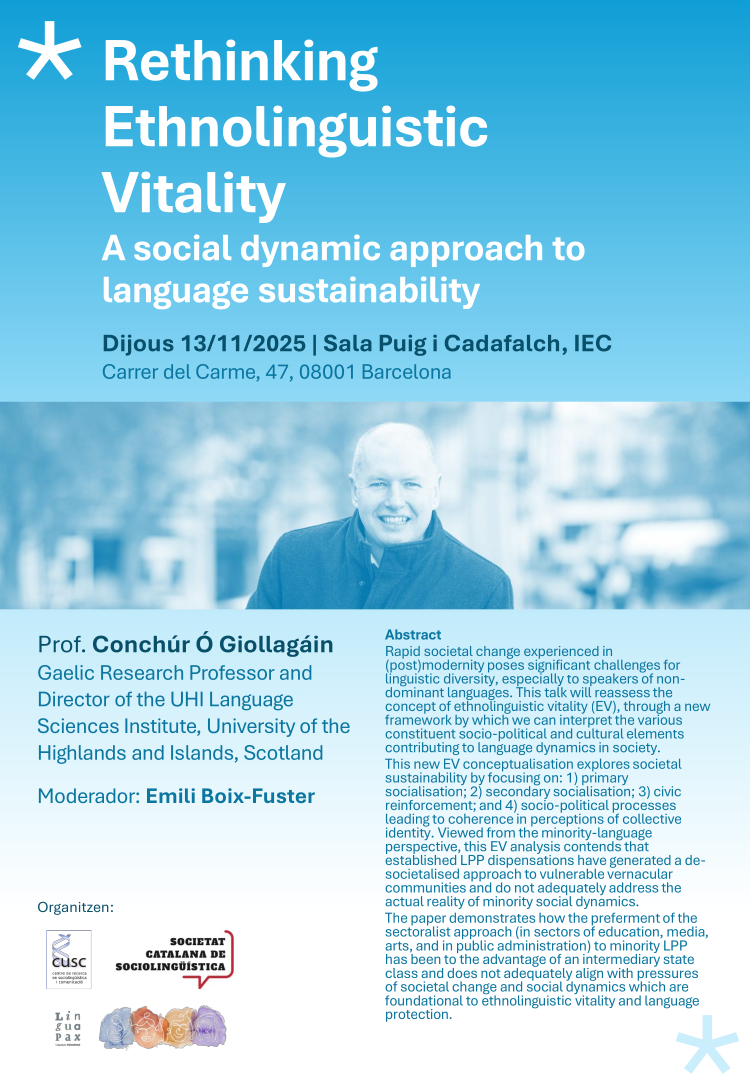
Language Sciences Institute Director, Professor Conchúr Ó Giollagáin delivered a lecture on "Rethinking Ethnolinguistic Vitality" on 13th November at L'Institut d'Estudis Catalans in Barcelona.
The PDF of the presentation is available online: PDF for Barcelona.
The abstract and references are given below:
Rapid societal change experienced in (post)modernity poses significant individual and collective challenges for linguistic and cultural diversity, especially to speakers of non-dominant languages. This talk will reassess the concept of ethnolinguistic vitality (EV) from an interactional social dynamic framework (Ó Giollagáin et al. 2025), informed by World Language Systems perspectives (de Swaan 2010), and rooted in vernacular ethnolinguistic data/analysis (Ó Curnáin & Ó Giollagáin 2024; Ó Giollagáin et al. 2007, 2015, 2020). Building on Ó Curnáin & Ó Giollagáin 2024, this EV research presents a new conceptual framework by which we can interpret the various constituent socio-political and cultural elements contributing to language dynamics in society.
This new EV conceptualisation entails four foundational processual stages in the social dynamics by which a language group develops and bolsters its societal sustainability: 1) primary socialisation; 2) secondary socialisation; 3) civic reinforcement; and 4) socio-political processes leading to coherence in perceptions of collective identity. Both the extent and inter-relations of these four processes are pivotal to positive cyclical social dynamics underpinning a group’s societal sustainability. The EV framework demonstrates the interaction of key groups of social participants (identified as minority; majority/majoritarian; tangential and neo-cultures), and how they influence the outplay of the dynamic in society. Viewed from the minority-language perspective, the analysis contends that established sectoralist LPP dispensations have generated a de-societalised approach to the concerns of vulnerable vernacular communities, as policy affairs do not adequately correspond to core aspects of the actual reality of minority social dynamics.
The paper demonstrates how the preferment of the sectoralist approach (in sectors of education, media, arts, and in public administration) to minority LPP (in western contexts) has been to the advantage of an intermediary state class – analysed through the Bordieuan lens of symbolic authority – and has led to formal dispensations for post-structuralist language promotion which do not adequately align with pressures of societal change, interactional processes, social dynamics which are foundational to a language group’s ethnolinguistic vitality. The paper will also enquire as to the similarities and differences in necessary language protection approaches between Western and non-Western contexts.
References:
De Swaan, A. (2010) Language systems, in Coupland, N. (ed.) The Handbook of Language and Globalization, 56–76. Chichester: Wiley-Blackwell.
Ó Curnáin, B. and C. Ó Giollagáin (2024) Minority language protection and promotion. In Gazzola et al. (eds.) The Routledge Handbook of Language Policy and Planning. Oxon: Routledge, pp 396–415. DOI: 10.4324/9780429448843-33.
Ó Giollagáin, C. et al. (2007; updated in 2015) Comprehensive Linguistic Study of the Use of Irish in the Gaeltacht. Dublin: The Stationery Office.
Ó Giollagáin, C. et al. (2020) The Gaelic Crisis in the Vernacular Community: A comprehensive sociolinguistic survey of Scottish Gaelic. Aberdeen: Aberdeen University Press.
Ó Giollagáin, C., Bourgeois, D., Ó Curnáin, B., Caimbeul, I., Cameron, G. 2025. Language Dynamics in Society (LanDS): The LanDS Analytical Framework for Majority and Minority-Language Ethnolinguistic Vitality. Treatises and Documents, Journal of Ethnic Studies Vol. 94. Issue 1 (June 2025): 25–75. DOI: https://doi.org/10.2478/tdjes-2025-0002