Update: Follow this link to get access to the recording of the Gaelic and Jamaican session on demand.
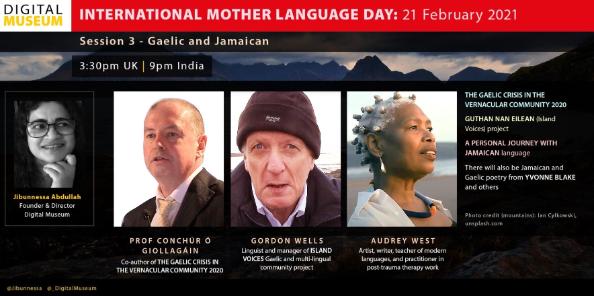
Island Voices come under the spotlight in this Digital Museum event on International Mother Language Day, Sunday 21st of February. We’re up in the third session of four in total that track westwards across the globe through numerous timezones under Jibunnessa Abdullah’s careful guiding hand. All session timings and links are available through the tweet below.
We’re on at 3.30pm Hebridean time in the Gaelic and Jamaican session, but you could usefully spend the whole of Sunday listening in to the various speakers from Bangladesh to the Americas!
Jibunnessa makes generous mention of Island Voices’ “innovative and energetic approach to improving language engagement and multilingual connections across the globe” on the registration page for this session. In a programme packed with interesting speakers there won’t be time to show any of our films in the session itself, but in the spirit the day celebrates we’ve selected a few below from across the years with a particularly international flavour that you might care to preview, as a reminder of (or introduction to) some of the things we do, and perhaps as a warm-up for the event itself. See you then!
Maggie Smith, from Achmore on Lewis, has been doing a power of work collecting and recording Gaelic stories and poetry around and about the island for a number of years, many of them curated on her own website, and reproduced on the Island Voices page dedicated to her work. Nor has lockdown stopped her, as she reveals in this conversation with Pàdruig Moireach conducted over Zoom.
This is a new and experimental departure for the Stòras Beò nan Gàidheal team, seeking to make a virtue out of necessity. Indeed, in some ways community recording work may become easier as more and more of us get accustomed to using technology to overcome physical barriers. If this works well, we can expect more of this kind of material in the months to come.
In the first part, Maggie talks about early childhood memories and stories of Glasgow where she was born, though her Achmore roots go back many generations. Returning home she recalls the kind of upbringing island children of her age received, in which community links and mutual responsibilities were strong. Grandparental stories from work experience in Patagonia, and snatches of Spanish at the fank guarded against cultural introversion. She recalls her schooling, and the impact of television’s arrival on cèilidh culture, with traditional work on the land noticeably falling off in the 80s, particularly after oil work began.
In the second part Maggie and Pàdruig talk about trends in island work patterns over the years. The advent of the Arnish yard led to skills development opportunities for men across Lewis, which many later put to use in openings around the world. Weaving was a traditional occupation, frequently practised in combination with other jobs. Even as a schoolchild Maggie was accustomed to fitting her schoolwork into other duties, such as fetching water for the house. After a short spell working in Inverness after school, she returned to work with the family haulage firm for many years, before branching out into media work, tourism and other projects.
In the third part Maggie talks more about her cultural activity in the community, including community drama based on locally sourced stories, and the collection of local poetry. Moving to Zoom during lockdown has created a new platform for locals to share stories and for incomers and Gaelic learners to learn about the culture, recreating old communities and gathering new people. She also talks about the power of music and song in working with older people at risk of memory loss, and of collecting fishermen’s stories, mostly in Gaelic. The conversation ends with a discussion of changes that have come over Achmore and the use of Gaelic in the community.
Our Craigard film was the first we ever made, and we keep returning to it for inspiration!
This week’s exciting news, following our posts last Friday and Saturday, is the addition of optional subtitles to the Island Voices Gaelic videos on our YouTube channel. When we asked who would be interested in such a development on our social media last weekend, the positive reactions quickly came back in their hundreds. (Some folk also wanted the reassurance that this would not mean the withdrawal of un-subtitled videos or of the Clilstore transcripts – we have no intention of doing either!)
Given the strongly expressed enthusiasm, the response from the Speech Recognition research project team has been instant and impressive. Systems have been set up to enable the automatic subtitling of all the Gaelic output on our Island Voices Videos YouTube channel, and all 20 films in Series One are already done – with the Craigard documentary in first place on the playlist. Keep an eye out for swift progress on Series Two and other films in due course!
The way in is through the CC “Closed Caption” button. To see any subtitles at all, that needs to be on. (So the default viewing remains clear of any textual additions.) You should now see the Gaelic subtitles.
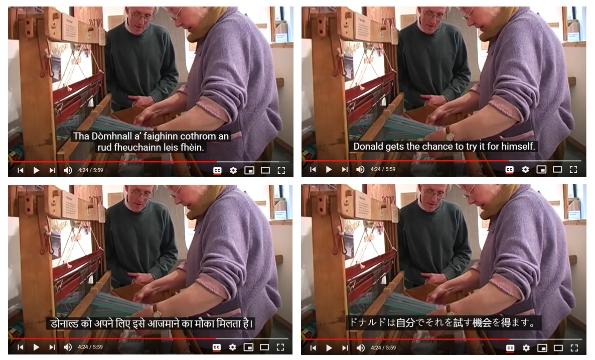
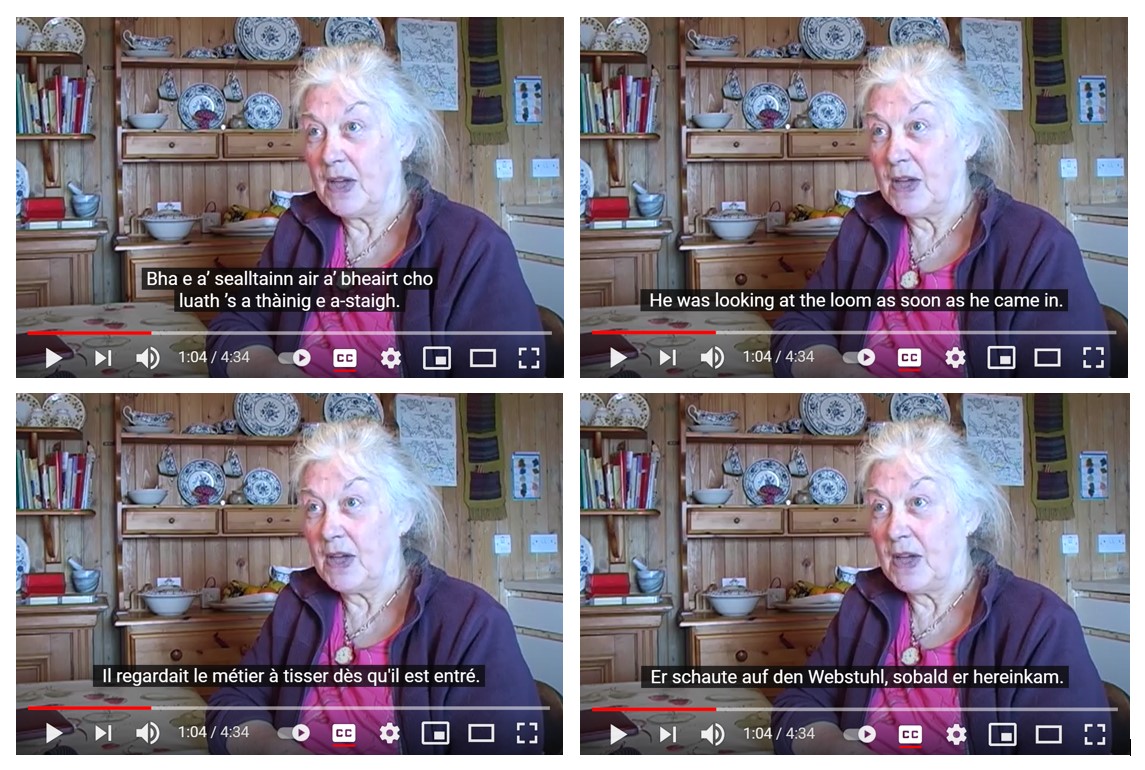
But that’s not all – once you have them on, there’s another clever little trick that enables Google Translate to work on them. If you go into Settings (next to CC) and then click on “subtitles” you’ll find an “auto-translate” option, which then opens a wide range of languages into which the Gaelic subtitles can be translated.
Machine translation remains an imperfect science, of course, so any expectation of error-free renderings will inevitably be disappointed. Nevertheless, even without this extra facility, Gaelic learners stand to benefit just from using the Gaelic subtitles alone as an extra support for their eyes to help their ears recognise what they’re hearing.
So here’s the Craigard film again – this time with the new multilingual subtitle functionality added.
Nor is this the first time that the Craigard film has taken the lead in test-driving new innovations and community adaptations. Donald Mackinnon’s re-voicing of the original films in Gaelic and English was our first step along the road to the re-purposing of many of our films in Other Tongues. And, much more recently, it’s the film Valentini Litsiou chose for her Greek contribution.
Donald in Gaelic:
Donald in English:
Valentini in Greek:
Who can say what the next innovation will be?
Gàidhlig agus Beurla, gu cinnteach – ach a bheil cànain eile aig Flòraidh NicDhòmhnaill? Agus ma tha, cia mheud!?
Abair seachdain “techie” a th’ air a bhith aig Guthan nan Eilean. Bha fèill mhòr Dihaoine is Disathairne sa chaidh air na fo-thiotalan “automataigeach” a chaidh a chruthachadh aig Oilthigh Dhùn Èideann ann am pròiseact Shoillse, ach dè eile a thàinig a-mach à sin ach cothrom fo-thiotalan a chur air na bhidiothan Gàidhlig uile gu lèir a th’ aig Guthan nan Eilean air YouTube! Cha ghabh an obair sin dèanamh taobh-a-staigh latha, ach tha an sgioba ris a’ ghnothach, agus tha Sreath 1 deiseil mar-thà.
Chan e sin deireadh an sgeòil ge-tà. Le fo-thiotalan “san t-siostam” a-nis tha sin a’ fàgail gur urrainnear “eadar-theangachadh” a thabhann cuideachd tro Google Translate air na fo-thiotalan sna bhidiothan. Cha bhi iad gun mhearachd idir, ach can nam biodh càirdean agad aig nach eil Gàidhlig: an dèidh dhut “CC” a chur air, faodar an uair sin na settings air “subtitles” atharrachadh gu “auto-translate” airson tionndadh air choireigin a thabhann dhaibh ann am Beurla – no Frangais, Gearmailtis, agus iomadh cànan eile.
Seo Flòraidh, ma tha, ann an Sreath 1, ri “leughadh” cha mhòr ann an cànan sam bith a thogras tu.
Agus mar chuimhne air a’ chuspair air a bheil i a’ bruidhinn, cuir sùil a-rithis air a’ phost “Community Adaptations” airson tionndaidhean eile (gun fo-thiotalan) fhaicinn dhe na filmichean aithriseach a thòisich an còmhradh, le seann charaid eile aig Guthan nan Eilean na rionnag annta…