INS Researchers Present Papers at the 20th Viking Congress 2026
UHI Institute for Northern Studies (INS), Professor Alex Sanmark, Professor Andrew Jennings, Professor Stefan Brink, and Dr Shane McLeod attended the prestigious 20th Viking Congress 2026, held in Oslo between August 8th and 17th 2026. Visiting INS Professors Judith Jesch from the University of Nottingham and David Griffiths from Oxford University were also in attendance.

In 2026, the delegates celebrated 76 years since the inaugural Viking Congress took place in Lerwick in 1950. In addition to addressing three themes related to the landscapes and social frameworks of the Viking World, a fourth theme encouraged reflections on future research and the dissemination of knowledge about the Viking Age in a changing world.
- Landscapes and resources
- Interactions, collaborations, and a sense of belonging
- The long Viking Age
- The future of the Viking Age – dialogues with the public
Professor in Island Studies Andrew Jennings presented his paper titled ‘Reinterpreting the Bressay Stone.’ The paper outlined a community research project that was initiated at the request of The Bressay History Group. It aimed to develop new educational and public engagement resources focused on the Bressay Stone, a significant local monument in Shetland. The project was funded through a grant from the UHI Knowledge Exchange Sectoral Challenge Fund.
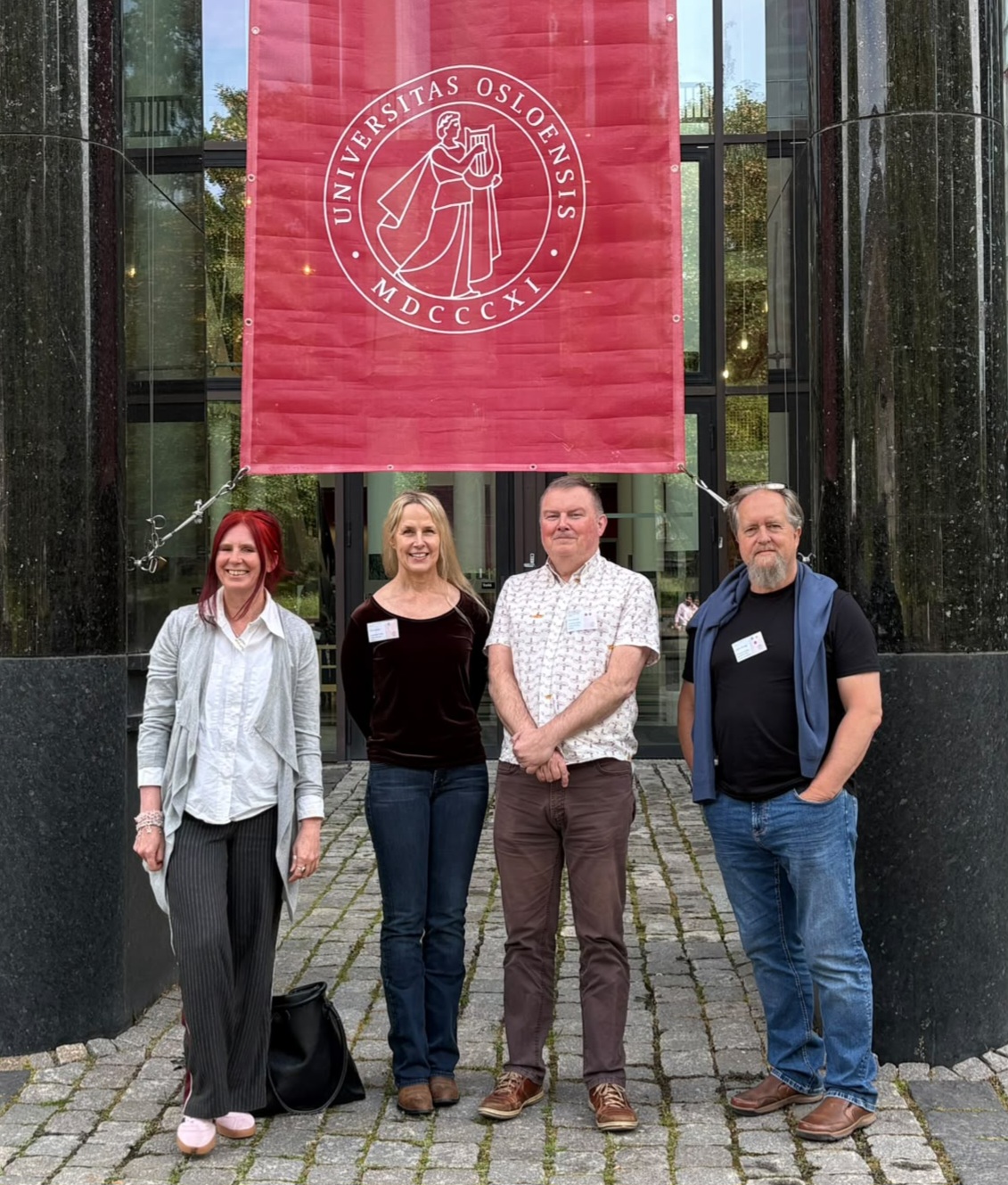
Professor Alex Sanmark, PhD Candidate Terri Barnes, Dr Shane McLeod and Professor Andrew Jennings
The paper explored the history, iconography, and linguistic significance of the stone, establishing it as a crucial monument of cultural convergence in 10th-century Shetland. Key findings highlighted the stone's unique hybrid characteristics, analysing its combination of Christian symbolism, such as robed clerics and a Jonah motif representing resurrection, with Insular artistic traditions.
The research provided a thorough analysis of the stone's Ogham inscription, which presents clear evidence of cultural fusion. The inscription combines Gaelic words like ‘cros’ (meaning cross) and ‘meqq’ (meaning son of) with the Old Norse word ‘dóttir’ (meaning daughter), as well as Norse personal names such as ‘Naddoðr and ‘Benises.’ This suggests that the stone's existence challenges simplistic narratives that depict Viking conquest as a means of cultural eradication. Instead, it indicates a more complex interaction where local traditions were adapted by incoming communities. Professor Andrew Jennings said:
“The Viking congress is a tremendous opportunity to meet colleagues and renew contacts. It's amazing to share in all the great Viking research that's being undertaken worldwide!”
Professor of Medieval Archaeology Alex Sanmark presented a paper entitled ‘Pictish and Norse Interaction in Viking-Age Scotland.’ In her presentation, Professor Sanmark examined the type and degree of interaction between Norse settlers and the Pictish population in Viking-Age Scotland. This is a highly debated issue, on which archaeologists and historians have often disagreed, partly because they view and interpret the evidence differently. The debate has now almost reached a standstill, despite intriguing new evidence emerging.
In terms of archaeology, terms such as ‘Pictish’ or ‘Norse’ are frequently used to label remains (burials, settlements, etc), thereby making it near impossible to examine any intermingling between the two ‘groups’.
Two other concepts which need re-examining are ‘pagan’ and ‘Christian’. Norse burials are in most cases identified as such by the grave-goods, and on the basis of this being present, they are labelled ‘Norse pagan’ graves, in contrast to ‘Pictish Christian’ burials. This juxtaposing of the two groups is clearly an oversimplification and highlights the problem of identifying any Norse Christians who may have been buried alongside Pictish Christians.
This issue should be compared to other areas where the Norse settled, such as England and Ireland, where much of the focus has been placed on interaction between the different groups, and where that is reflected in the terminology, with expressions such as Anglo-Norse, Anglo-Scandinavian and Hiberno-Norse. While acknowledging that the situation in Scotland was different, Prof. Sanmark argues that the absence of any such terminology for Scotland hinders the progress of research. Professor Alex Sanmark added:
“Attending this conference has been a fantastic experience. It has provided an opportunity to make new international connections which INS will be building on in the future.”
Dr Shane McLeod presented findings from the ‘Norse and the Sea’ project, an extensive research initiative dedicated to unravelling the complex maritime cultural landscape of Scandinavian Scotland during the significant timeframe from AD 790 to 1350. He has also attended meetings about Viking Age beacon sites, beach markets and international trade networks. INS Doctorate student Terri Barnes, from the USA, also attended the Congress and Shane and Alex took the rare opportunity to have an in-person supervision.