Student’s carved head find included in Smithsonian magazine’s top discoveries of 2025
The carved stone head found by one of our undergraduate students in Rousay has made it on to the Smithsonian Magazine’s list of top discoveries of 2025.
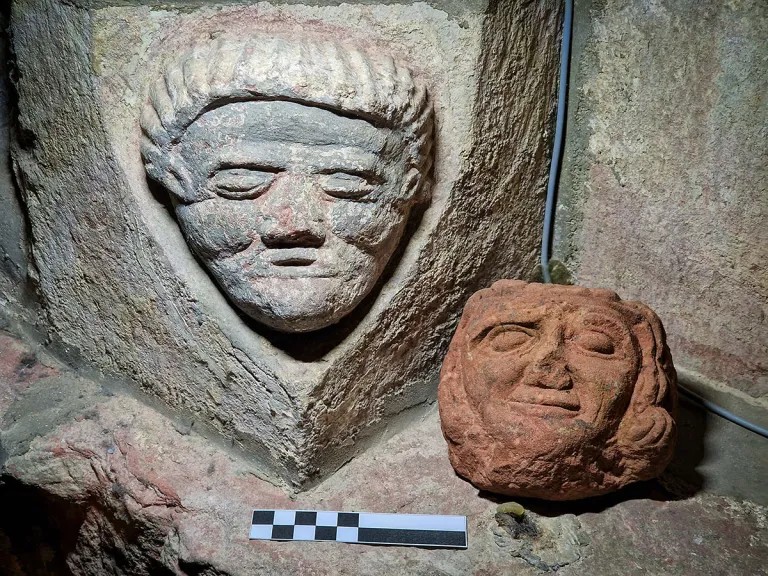
This marvellous find turned up at our excavation fieldschool at Skaill, Rousay, and came as something as a surprise. The honour of its discovery goes to final-year student Katie Joss, whose BSc dissertation is looking at 19th century animal bone and diet at the farm site.
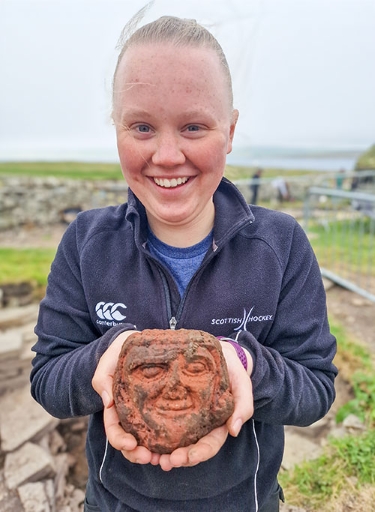
July 2025: UHI Archaeology Institute student Katie Joss with the Skaill carved head. (ORCA)
As Katie explained at the time:
“It was quite a shock, we were removing a slab when the head came rolling out at us and as we turned it around we saw a face looking back at us.”
Skaill is a multi-period site, in use from the Norse period until it was abandoned in the 19th century.
The finely-carved stone head emerged from a range of buildings from one of its later phases, perhaps dating to the 1700s. This was built on top of the remains of an earlier structure and produced a finely carved, and spectacular, stone head.
The carving was fashioned from red sandstone and worked examples of this material have been found around the site in previous years – perhaps relating to the nearby St Mary’s church.
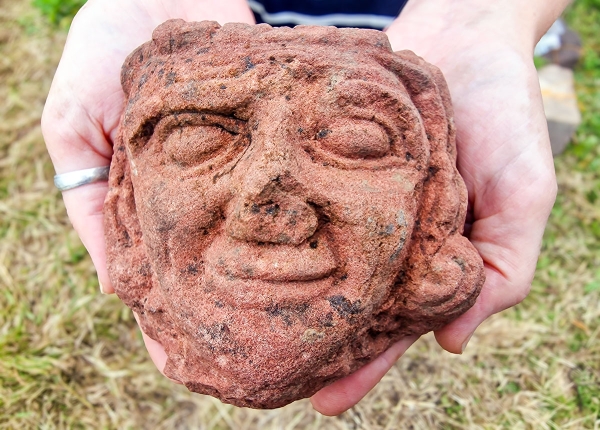
July 2025: The Skaill carved head.
The head is similar to carvings from the earlier phases of the 12th century St Magnus Cathedral in Kirkwall. During her investigations, Skaill co-director Dr Sarah Jane Gibbon has noted one in particular, in a window frame in the south aisle, close to the cathedral’s south transept.
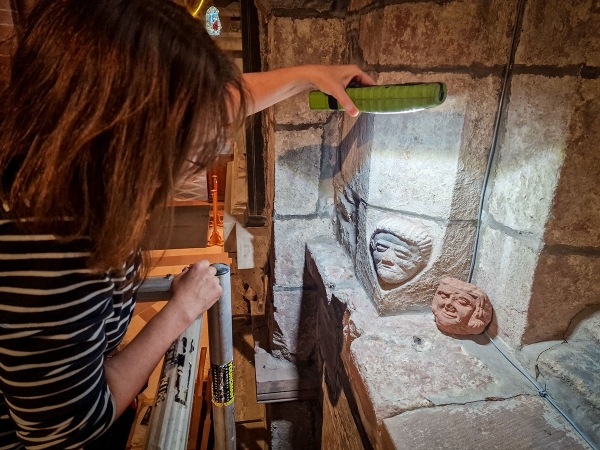
Dr Sarah Jane Gibbon comparing one of the carvings in St Magnus Cathedral to the Skaill head. (Dan Lee)
Sarah Jane explained:
“For now, the Skaill head must remain a fascinating enigma in terms of date, origin and use, but its discovery, along with many other fine pieces of carved red sandstone, as well as those built into the nearby old parish church of St Mary, strongly suggests a building of some splendour once stood in the vicinity.”
Why the carved head ended up in the remains of a much-later farm building remains unclear. But it, and the other examples of high-quality masonry that found its way into the later farm deposits, strengthens the idea of a high-status Norse church at nearby St Mary’s that predates the surviving remains and may have been connected to Sigurd of Westness.
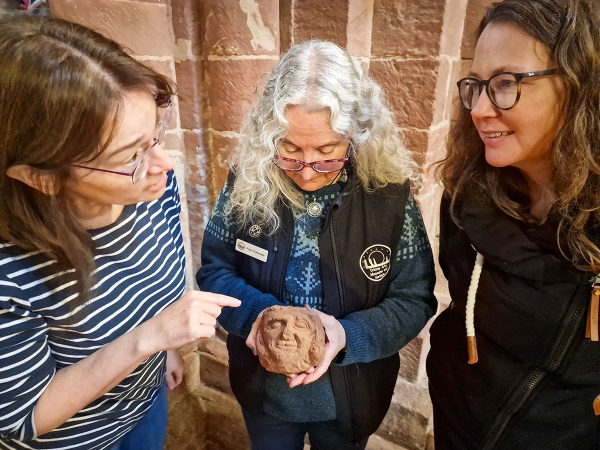
The UHI Archaeology Institute’s Dr Sarah Jane Gibbon (left) and Dr Jen Harland discuss the Skaill head with St Magnus Cathedral curator Fran Flett Hollinrake. (Dan Lee)
If you are interested in archaeology, follow the links for details of our undergraduate, postgraduate and research degrees.