James Hunter Dissertation Prize 2025: Joy Rollinson
We had the great pleasure of chatting with our 2025 winner of the James Hunter Dissertation Prize, Joy Rollinson, to learn more about her time at UHI Centre for History, her prize-winning dissertation and plans for the future
Why did you choose to study at UHI Centre for History?
Before studying with UHI I was homeschooled by my parents from a young age. Being homeschooled provided me with an unconventional and quality education and allowed me to sit my exams three years before the standard sitting age. I took a gap year when moving to Caithness and proceeded to study my history degree with UHI.
Before studying my degree I had always been uncertain about what career path I wanted to take. I had always loved history, whether watching old war films or reading historical novels, so I decided that I would pursue my interest in history and study a degree. I am very family-oriented and as I had just moved to Caithness with my family UHI worked for me because it allowed me to study a history degree from home and required independent study, something which I was familiar with from being home-schooled. I also appreciated the opportunity I had to use the local Thurso campus with its library and study.
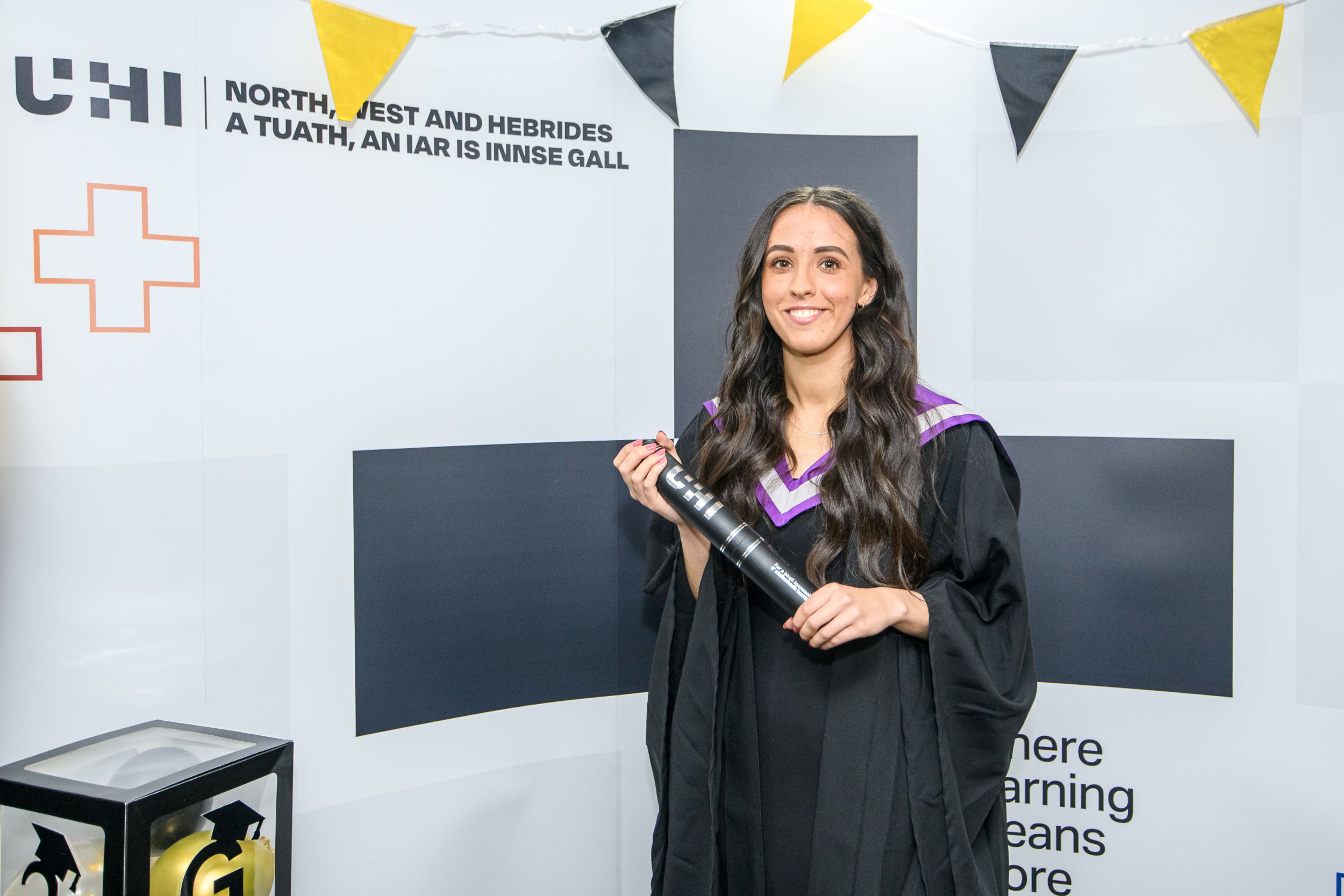
Joy Rollinson (Angus Mackay Photography)
What are some of your personal highlights about studying History at UHI?
I enjoyed the enthusiasm and expertise of the history lecturers at the Centre for History and the opportunity this gave for a better understanding and discussion of the modules on the course. The history lecturers were approachable and always appreciated further discussion on topics and sharing your own thoughts. The small class sizes allowed for students to share their thoughts and enthusiasm about topics with each other, which I found very useful because of the fully online structure of the course.
The UHI history course was heavily focussed on the history of the Highlands and Islands, medieval history, and North American history, but within each module there was the opportunity for students to select the areas within the modules that they would like to study further. This allowed me to undertake historical studies of areas local to me in Caithness, which is a history I am very interested in. The structure of the UHI humanities degrees also allowed me to study modules in archaeology. I found archaeology very interesting and complementary to my history courses as it allowed me to gain wider understanding of the history of the Highlands and Islands. I have a new interest in archaeology and have gained new understanding and appreciation of how the two disciplines can be studied together to gain a more comprehensive understanding of the past.
What are the most important skills you have developed during your degree?
One of the most important skills that has been developed during my degree is my critical thinking and attempt to always be unconventional to the norm. I have always been taught to question everything and to not accept anything before researching it myself.
My undergraduate degree has allowed me to develop these skills, as it has taught me that in order to understand history we need to read into and critique the numerous and multi-faceted contributing factors to historical events and how they are recorded and manipulated over time. I was initially motivated to learn about history from my Dad who frequently said that if we do not learn from history we will forever make the same mistakes. Studying my history degree has taught me that history is not just an academic discipline but something that should be used to prevent the same historical mistakes happening again and to learn about humanity.
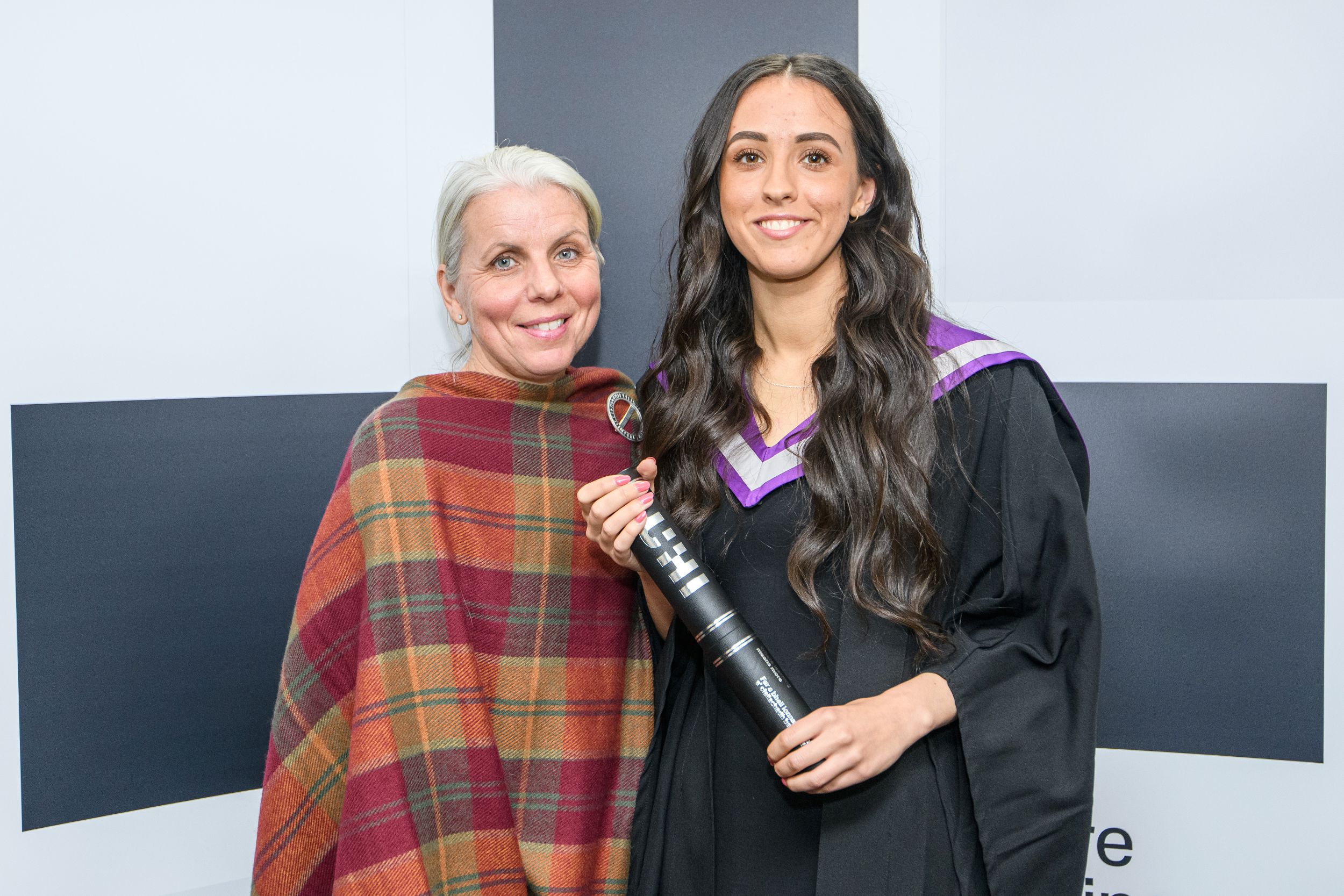
Joy Rollinson with her mother, Karen Rollinson (Angus Mackay Photography)
When I started my degree my interest was in modern history, and while this remains so, I now have a newfound enthusiasm about the Highland Clearances and North American history which have been taught on my course. They have shown me how the study of history is essential in understanding the narratives of those who have been either ignored or marginalised within the historiography, and how fruitful the study of these groups can be. Most of the history modules at UHI were centralised around the literature and documents produced from the time, which formed the centre of our research and understanding of the topics and were very interesting and educational.
Can you tell us about your prize-winning dissertation? What sorts of factors guided your choice of topic?
When I started my history degree I knew that I wanted to study the Second World War for my dissertation. From a young age I had been very interested in how the war was presented both during the war and also in modern times, and how facts were controlled in order to maintain morale but also to create the historical narrative of war after 1945. I grew up watching old films about the war and admired the fashion and culture of this time, an interest which I shared with my Granny Iris, to whom the dissertation is dedicated.
I was particularly interested in how war films took on the common theme of promoting the heroism and stoicism of the British public juxtaposed with the antagonism of the enemy. When I came to choose the subject of my dissertation, with the help of my supervisor Dr Alison Chand, I decided to incorporate my interest in both the way that historical narratives had been crafted about the war and also my interest in 1940s culture into studying propaganda films produced during the Second World War. The reason that I decided to study short films in particular was because I became aware that while feature films had been extensively studied by historians, the short propaganda films shown to audiences at cinemas had never been studied in isolation.
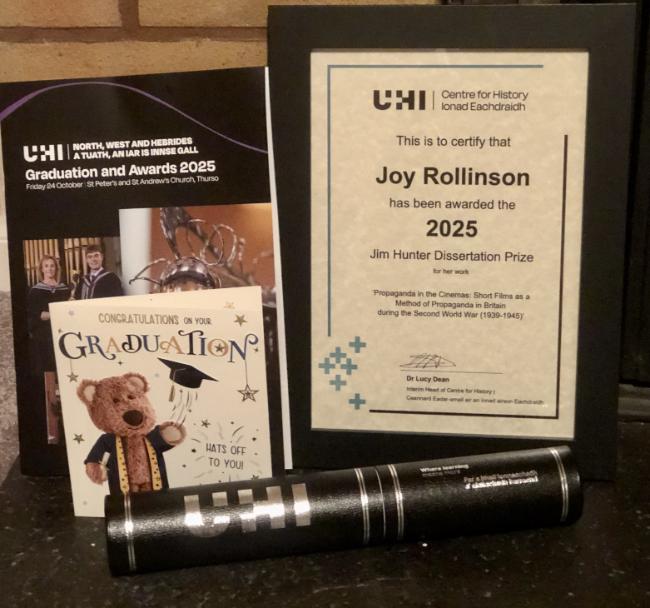
Before studying my degree I had been unaware that when cinema audiences went to see a film during the war they would be shown numerous short propaganda films before the main picture. These short films formed a central part of the Ministry of Information’s propaganda drive and were used for a plethora of purposes, such as to increase morale, control behaviour, or provide information to citizens. It was fascinating to explore how the Ministry of Information used short films as a method of propaganda by infusing key propaganda messages with comedy and drama, and reaching a large number of people through the popularity of the cinema. I found the research for my dissertation very interesting and it felt very rewarding studying something that had received little focus within the historiography. Additionally, these short films were very enjoyable to watch on their own and provide a great insight into 1940s culture, film production, and comedy.
"It was a real pleasure to supervise this insightful and fascinating study, which offers a unique contribution to Second World War propaganda history. The Ministry of Information short films, the central focus of Joy’s dissertation, are not a particularly well-known part of the British government’s wartime communication strategies, and Joy has really delved into their content to explore what they tell us, in research prompted and underpinned by her own personal interest. Congratulations!" - Dr Alison Chand
What did winning the James Hunter Dissertation Prize mean to you?
When I completed my degree and was awarded a first-class degree I was extremely happy and pleased that my hard work had achieved me something that I had been working towards for four years. I was not expecting to win the James Hunter Dissertation Prize, but when I did I was very surprised but greatly honoured.
My history dissertation had been crafted very carefully and had been something I had been thinking about since starting my degree. I had chosen a subject which I enjoyed but that was also very understudied within history. To be awarded the James Hunter Dissertation Prize was a great achievement and I am very honoured that my work was chosen for this award from all of the other first-class dissertations. The extensive research that I had done in the subject, and the numerous discussions I had with my supervisor about how to structure the dissertation was made worthwhile with the recognition of this prize. I received a very kind email from James Hunter about my dissertation and his shared interest in the historical value of the short films.
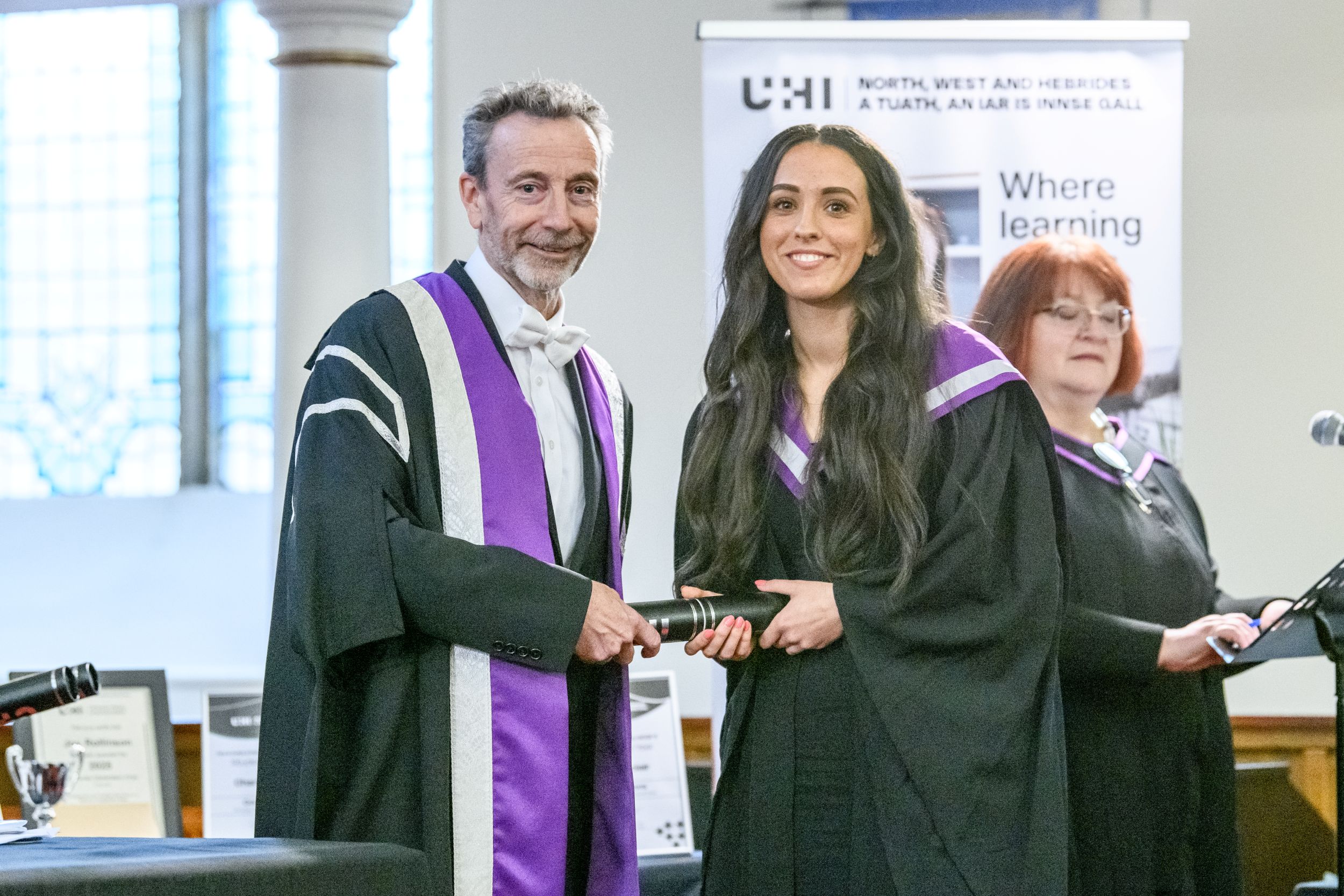
Joy Rollinson with UHI Deputy Principal Academic and Research, Professor Brian Williams (Angus Mackay Photography)
Winning the prize was very important because it made me reconsider my future study. Initially I had not planned on continuing to do my masters but the recognition and the comments that I received about my dissertation, made me decide to study my masters degree in history. Unfortunately, it was too short notice for me to enrol for my masters this academic year but it is something I am looking to do next year, and hopefully I will continue to study short film propaganda, and continue my research in more depth.
What are your future plans?
Since completing my degree I have set up my own baking business in Caithness. This is something I am very passionate about and would like to pursue, either alongside studying my masters, or if I find a job that utilises my history degree.